Last updated: November 2026.
Vietnam stretches more than 1,600 kilometers from north to south, from the mountains on the Chinese border to the rice fields of the Mekong Delta. That makes it a country of contrasts: busy cities and quiet villages, limestone bays and white beaches, imperial palaces and street food. Below you’ll find all our destination guides, grouped by region, with tips on how to combine them.
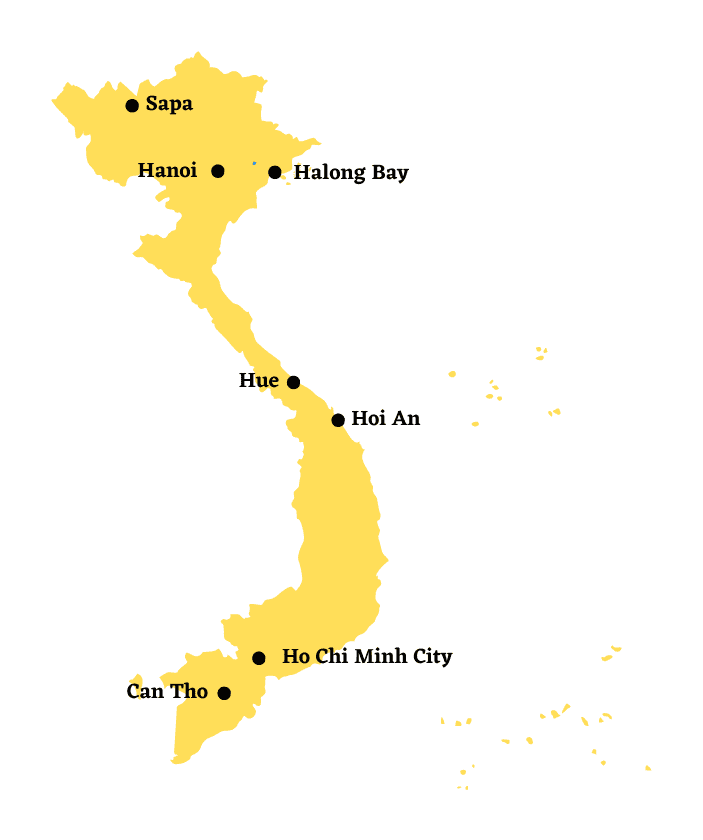

North Vietnam
The north is the cultural heart of Vietnam, with the capital Hanoi, the limestone islands of Halong Bay and the rice terraces in the mountains around Sapa. Winters are cool here; spring and autumn are the best time to visit. Read more about North Vietnam.
- Hanoi: the capital, with the Old Quarter, Hoan Kiem Lake, Train Street and some of the best street food in the world.
- Halong Bay: nearly 2,000 limestone islands in an emerald bay, by day cruise or overnight on a boat.
- Sapa: rice terraces, mountain villages and trekking among the ethnic minorities of the north.
Central Vietnam
The center combines history with beaches: the imperial city of Hue, the lantern-lit old town of Hoi An and the scenic Hai Van Pass in between. The dry season runs from February to August; the autumn is wet. Read more about Central Vietnam.
- Hue: the former imperial capital, with the citadel, royal tombs and the Perfume River.
- Hoi An: a UNESCO-listed old trading town, with tailors, cycling through the rice fields and beaches nearby.
South Vietnam
The south is tropical and warm all year round, with the energy of Ho Chi Minh City and the green waterways of the Mekong Delta. The dry season runs from December to April. Read more about South Vietnam.

- Ho Chi Minh City: Vietnam’s biggest city, with markets, colonial buildings, war history and great food.
- Mekong Delta: floating markets, boat trips through the canals and life on the water.
Suggested routes
Two weeks: the highlights
- Days 1 to 3: Hanoi
- Days 4 to 5: Halong Bay
- Day 6: night train or flight to Hue
- Days 7 to 8: Hue
- Days 9 to 11: Hoi An, via the Hai Van Pass
- Days 12 to 14: fly to Ho Chi Minh City, with a day trip to the Mekong Delta or the Cu Chi Tunnels
Three weeks: at a relaxed pace
Follow the two-week route and add Sapa (2 to 3 days) or Ninh Binh (1 to 2 days) in the north, an overnight stay in the Mekong Delta (2 nights) in the south, and finish with a few days on the beach, for example in Hoi An or on the island of Phu Quoc.
Tip: fly into Hanoi and out of Ho Chi Minh City, or the other way around, so you don’t have to travel back. Read more on our Flights to Vietnam page.
Plan your trip
- When to go: each region has its own climate. See our page on the best time to visit Vietnam.
- Getting around: our Getting Around page compares flights, trains, buses and taxis, with advice per route.
- Before you go: check the visa requirements, read about money and arrange an eSIM.
- Food: don’t miss our guide to Vietnamese street food.